
Answering The Call
9 min read

Holy Dreaming
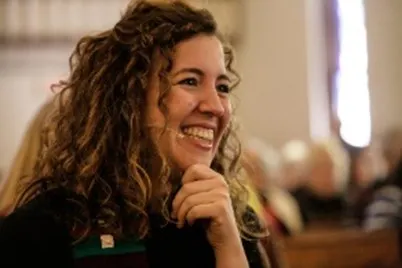
by Emily C. Goodnow
Senior Pastor at the First Congregational United Church of Christ of Bridgton, Maine
The Rev. Krista Betz, Director of Leadership Initiatives for the United Church Board for Ministerial Assistance, interviews the Rev. Emily C. Goodnow, Senior Pastor, First Congregational UCC of Bridgton, Maine, on the impact of the Next Generation Leadership Initiative (NGLI) model, which led to the creation of “Nurturing Children through Worship and Prayer Practices” program. Rev. Goodnow was a participant in the NGLI*5 cohort.
For 15 years, the United Church Board for Ministerial Assistance (UCBMA)—the philanthropic arm of the Pension Boards—has offered a transformative leadership initiative to local church pastors in their 20s and 30s. The Next Generation Leadership Initiative (NGLI) equips and energizes younger UCC local church pastors to co-create vibrant congregations that change lives, engage communities, and further God’s mission in the world. Given that up to 46% of pastors under the age of 40 say they have considered quitting full-time ministry in the last year (Barna 2021), it is cause for celebration that NGLI has a 70% graduation rate. As of January 2025, NGLI has graduated 65 local church pastors, and we celebrate how each one has found the courage and creativity to serve their congregations.
Over the years we have shared in this space about the experiences that occur during the NGLI journey and this year the focus is on one of the graduates—the Rev. Emily Goodnow, who completed the NGLI program in January 2025. Discover how she was invited to be “leaven” and how that seed blossomed in surprising and sustaining ways in her ministry.
—The Rev. Krista L. Betz, Director, Leadership Initiatives
Rev. Betz: When you began your NGLI journey in 2015, how did the invitation to be "leaven" for the church and world impact your thinking?
Rev. Goodnow: I knew NGLI was going to be a soul-stirring, ministry-shifting experience since the first dinner our cohort shared together at orientation. Krista challenged us with sharing this gift, to be yeast and leaven within the wider church. It was easy (and transformative!) to implement NGLI wisdom into my ministry and life, and immediately the learning and growth I experienced in the program brought yeast and leaven to my ministry. My church and I thrived, but the charge wasn’t just for us; it was also to share the gift beyond the boundaries of our settings and silos.
I struggled to write a newsletter article explaining to my church why I’d been at an NGLI event. I thought, how can I share this gift if I can’t even explain what it is? I encouraged others to apply and spoke to colleagues about the program in hopes that their denominations might do similar work, but that all felt insignificant. Because the gift really was so profound, all the small ways I shared wisdom from the program with others felt, well, small. It has been a holy practice to sit for 10 years wondering how to share this transformative experience with others in a way that offers thriving, yeast, and leaven to their ministries.
Rev. Betz: What inspired the application to the Lilly Endowment’s “Nurturing Children through Worship and Prayer Practice Initiative,” which your congregation recently received a $1.25 million grant to begin?
Rev: Goodnow: I stumbled upon the grant application when I was looking for something else (much how I happened upon NGLI, actually!) and because I serve a congregation that dares to dream, I brought the possibility to a small group of leaders who all said, “Let’s do it!” We have a delightful history here of experimentation and playfulness, and I credit NGLI with teaching me how to foster a community that can do both.
We knew we were unlikely candidates for the grant (it’s intended for larger organizations), but we had some generous church leaders who were willing to put in time to craft a vision and translate it into an application. It was a real group effort (because, as NGLI teaches, we don’t go into the swamp alone!) and we had the right mix of big ideas, folks with experience in the grant world, and even a poet who penned much of the text in beautiful prose. The original idea came from a conversation between my Christian Education Director and me; she suggested we create a program where area congregations could learn from us and receive micro-grants to invest in their own programs. I knew immediately that grouping the churches into cohorts and loosely modeling the whole program on NGLI would not only make for a strong application, but it would also be an answer to a prayer I’d been praying for a decade now.
Rev. Betz: What are the primary goals of the program? What changes and connections do you hope to experience?
Rev. Goodnow: The goal of the program is to equip area congregations with space for holy dreaming so that they can better serve the children in their communities. We will do this by providing the leaders of participating congregations with colleagues and collaborators to dream with, funds to put toward their dreams, and experts to help guide their work. Participating church leaders will take part in year-long learning cohorts with whom they will workshop ideas, design experiments, and celebrate successes. They will receive grant funds in two disbursements and together attend a conference, hosted by the grant, with experts who will consult with churches on their particular hopes and programs.
At the end of this five-year program, I hope more children in Western Maine will be loved and cared for. I hope churches will become safety nets and refuges for children and families in their communities. I hope area churches will shift to a culture of experimentation and innovation and trust their leaders to take holy risks. Overall, I hope area church leaders form life-long partnerships that open doors for new inter-church and inter-denominational collaboration, worship, fellowship, and play.
Rev. Betz: What did you learn about the value of cohort learning from NGLI?
Rev. Goodnow: I used to say our NGLI cohort could attend a plumbing conference together and I would learn things that would deepen and enrich my ministry. NGLI taught me the power of big learning within a sacred community. The cohort experience was academic, personal, and communal all at once. It allowed me to be more vulnerable and pushed me to explore ideas I might not have otherwise considered. It provided relationships that continued for me long after conferences and trips ended, which meant the learning continued informally as well as formally. Our cohort developed our own jokes, our own rituals, and our own shorthand for challenging concepts; one moment together could contain all three, which was truly delightful.
Transforming Leaders for the Church of the Future
The Next Generation Leadership Initiative (NGLI), administered by the United Church Board for Ministerial Assistance, the philanthropic arm of the Pension Boards, is a six-year program that equips and empowers younger UCC local church pastors to lead and build vibrant congregations.
by The Rev. Emily C. Goodnow
The Rev. Emily C. Goodnow is the Senior Pastor at the First Congregational United Church of Christ of Bridgton, Maine. She is passionate about creative worship, intergenerational community, and gospel-centered living. Prior to First Church, Rev. Goodnow worked at the First Congregational Church UCC of Salem, Oregon, the Telling Room in Portland, Maine, and Save the Children in Bamako, Mali. She received a Master of Divinity from Yale University and a B.A. in Creative Writing and Religious Studies from Colby College. She lives in Lovell, Maine with her husband, Noah, their three-year-old Silas, and a rescue dog named Edith.
Younger people called to ministry do not carry around the burden of the way things were in the 'good old days'... they seek emotional engagement with their faith.Rev. Dr. Sarah Drummond
RELATED ARTICLES
Adapting to Feelings of Failure: Individuality and Community with NGLI